The payout
How a voyage's payout is calculated, the daily rate of the route for each day at sea, the market move of the destination benchmark and the floor.
On this page
When a voyage settles, every share on it is paid out. The payout has two parts: a base yield for the days at sea, and a market move that follows a real oil benchmark between the departure day and the arrival day. A floor limits how much a share can lose. This page explains the formula and shows worked examples.
The formula
For each share:
Payout = the larger of (Share + Base yield + Market move) and (Share × floor)
| Part | How it is calculated |
|---|---|
| Share | The amount you put in |
| Base yield | Share × the route's daily rate × days at sea |
| Market move | Share × (arrival-day fix ÷ departure-day fix − 1) × 1 |
| Floor | 90% of the share |
There is no upper limit.
The base yield
The base yield is the route's daily rate for every day at sea. The daily rate depends on the length of the route, so a longer route pays more for each day, not only for more days:
- A route of 3 days or less pays the base rate, 1% a day.
- From there the daily rate rises evenly with every extra day at sea.
- A route of 40 days or more pays 1.6% a day, 1.6 times the base rate. Over 40 days at sea, that adds up to 64%.
The days are the route's days at sea, in whole days, as they were at the voyage's first share. Nothing else counts: the loading time, the queue, weekend parking, unloading and any wait for a price add nothing and take nothing away. Right now the open routes run from 3 days (3% a voyage) to 36 days (55.26% a voyage). Every route's daily rate and base yield are in the table of all routes.
The market move
The market move follows one benchmark: the benchmark of the destination port. Ports in Europe settle on Brent, ports in Asia on Dubai, and Long Beach on WTI. Your flag's grade is not used. Each route's benchmark is listed in Routes and positions.
The game compares two daily fixes of that benchmark:
- The departure-day fix: the fix of the UTC date on which the tanker departed.
- The arrival-day fix: the fix of the UTC date on which the tanker arrived at the destination. Not the day it got a berth, and not the day it finished unloading.
A Saturday or a Sunday is replaced by the Friday before it. Only the fix of that exact day is used.
The change between the two fixes, in percent, is multiplied by the multiplier (now 1). The result is the market move, in percent of your share. For example, with a multiplier of 1, a rise of 5% adds 5% of your share, and a fall of 5% takes 5% away. What a daily fix is: Prices and daily fixes.
Examples
These tables are calculated live with the game's current rates. Each one uses the daily rate of a route of that length. All four use a share of 100 🛢️.
Price up. 14 days at sea, the destination benchmark rises by 5%:
Price flat. The same voyage, the benchmark ends where it started:
Price down. The same voyage, the benchmark falls by 15%. The base yield and the fall are added together:
A crash. A short route of 4 days, and the benchmark falls by 30%. This is where the floor matters. The note under the table says if it applies:
A share pays back less than you put in only when the market move takes away more than the base yield adds. On a short route the base yield is small, so a smaller fall is enough.
The floor
Whatever the market does, a share is never paid less than 90% of what you put in. So the most a settled share can lose is 10% of its amount.
When the terms are fixed
The numbers a voyage pays with are fixed at its first share, and they are the same for every share on that voyage:
- the daily rate of the route,
- the number of days at sea,
- the multiplier,
- the floor,
- the tanker's capacity.
A later change of the game's settings does not touch a voyage that is loading, at sea or at its destination. An empty tanker in port shows the values in force right now. If every share of a loading tanker is cancelled and the tanker becomes empty again, the next first share takes the values in force at that moment.
At settlement the arrival-day fix and the market move are fixed too, so all shares on one voyage are paid on identical terms.
Where you see your payout
- Before you buy. The tanker sheet shows Expected on arrival: your amount plus the base yield. The market move is not in it. See Buying a share.
- During the voyage. In My positions, Expected becomes a live estimate once the tanker has sailed. It uses the latest daily fix of the destination benchmark and changes when a new fix arrives. See Routes and positions.
- At settlement. The payout goes to your balance by itself, with the history line Voyage payout. There is nothing to claim.
The payout screen
The next time you open the app, or come back to it, a screen celebrates the voyage: Voyage complete, or the number of voyages when there are several.
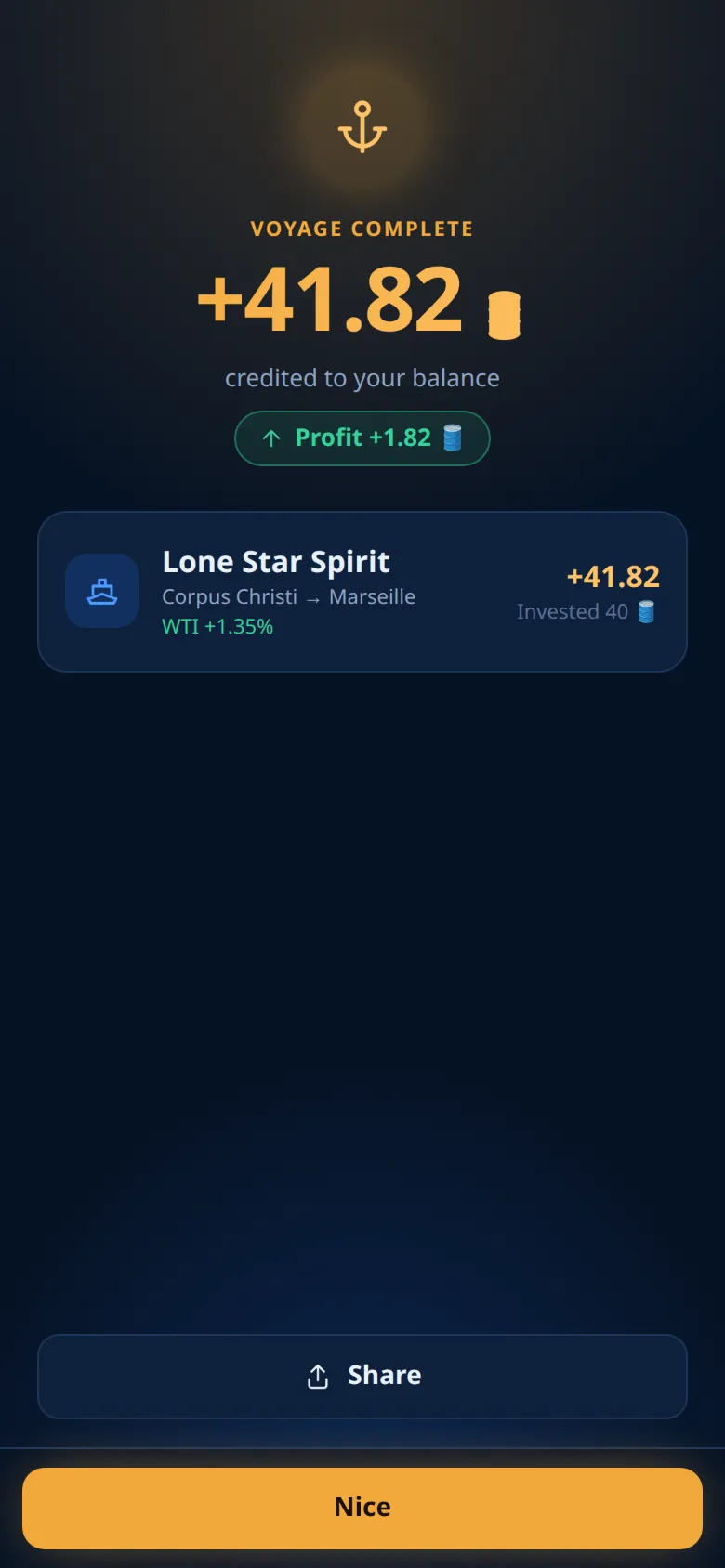
It shows the total paid, credited to your balance, a Profit chip (payout minus the amounts you put in) and one row per share with the tanker, the route, the benchmark and its move. Nice closes it. Share lets you share the result in Telegram.
For a free share, the whole payout goes to your balance. The Profit figure still subtracts the free amount, as if you had paid it.
Rounding
Amounts are counted to 0.000001 🛢️; anything smaller is cut off. Balances and lists show fewer decimals and cut the rest too; they never round up. So a payout can look a little smaller in a list than on the payout screen.
Warning
Oil Voyage is a game, and no real oil is bought or sold. There is no guaranteed income. The result of a voyage depends on real market prices, which can move against you, and on game rules that may change. You can lose part or all of what you put in, and you take that risk yourself. See the Terms of Use.
Ready to sail?
Open Oil Voyage in Telegram and load your first tanker.